
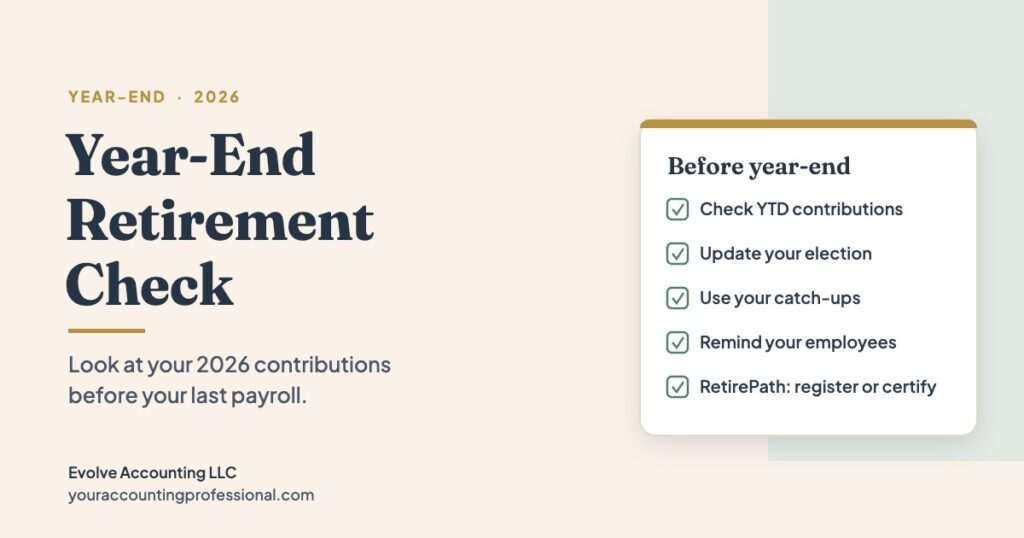
Right now, with only a handful of paychecks left in the year, is the best time to check your retirement contributions for 2026. Most of these contributions have to run through payroll by December 31, and once the last paycheck is out, the window for 2026 mostly closes.
I’d rather you spend 15 minutes on this now than find out in March that you left money on the table, or worse, put in too much. No judgment if you haven’t looked all year. That’s exactly why I’m writing this.
If you have employees in Virginia, there’s a second piece: talking to your team before year-end, and making sure you’re squared away with RetirePath Virginia. I’ll cover both below.
2026 limits at a glance
These are the IRS limits for 2026. The catch-up amounts are on top of the base limit.
| Plan type | 2026 base limit | Age 50+ catch-up | Age 60-63 catch-up |
|---|---|---|---|
| 401(k), 403(b), most 457 plans | $24,500 | $8,000 | $11,250 |
| SIMPLE IRA | $17,000 | $4,000 | $5,250 |
| Traditional or Roth IRA (including RetirePath) | $7,500 | $1,100 | Same as 50+ |
| Total 401(k), employee + employer | $72,000 | Catch-ups go on top | Catch-ups go on top |
| SEP IRA (employer only) | 25% of pay, up to $72,000 | None | None |
Two other numbers worth knowing: the most pay a plan can count is $360,000, and if you earned more than $150,000 in FICA wages in 2025, your 2026 catch-up contributions have to go in as Roth.
How to check your retirement contributions, plan by plan
Start by pulling your most recent pay stub or your payroll report and finding the year-to-date line for retirement contributions. Compare it to the limit above, then divide what’s left by the paychecks you have left. Here’s what to watch for with each type of plan.
401(k) at work
Your deferrals only count for 2026 if they come out of a 2026 paycheck. If you want to catch up, change your election now so it hits the next payroll. If you changed jobs this year, add both employers together. The $24,500 limit is per person, not per plan, and your new employer has no idea what you put in at the old one.
Solo 401(k) (self-employed, no employees)
You get both an employee deferral and an employer contribution. If you run payroll through an S corp, your employee deferral has to come out of your W-2 wages by December 31. The employer piece can usually wait until the business return is filed. This is also a good time to make sure your salary is set where you want it, because your contribution depends on it. My free Owner Pay Worksheet can help you think that through.
SIMPLE IRA
Employee deferrals need to run through payroll by December 31. You can deposit the employer match or 2% contribution up to the business tax return due date, including extensions.
SEP IRA
There’s no employee deferral here, only an employer contribution of up to 25% of pay. You can open and fund a SEP up until your tax return due date, including extensions, so this one has some breathing room. If you’re an S corp owner, the 25% uses your W-2 wages, so your year-end payroll still matters.
Traditional or Roth IRA
You have until April 15, 2027 to make 2026 contributions. If you’re over the Roth income limit, a traditional IRA or a backdoor Roth may be the better fit. If you also save through RetirePath, it shares this same $7,500 limit (more on that below).
If you have employees, talk to them about retirement contributions now
Your employees are probably not checking their pay stubs for this, so a short note from you can make a real difference. Send it before your next payroll so there’s still time to make changes. A few things to include:
- Check your year-to-date retirement contributions. Tell them where to find it on their pay stub and what the 2026 limit is for your plan.
- Changes need to happen soon. Let them know the last date you can process a new election before the final 2026 payroll.
- Catch-ups. Anyone turning 50 or older by December 31 can put in extra this year. Those turning 60 through 63 can put in even more.
- Higher earners and Roth. If someone earned more than $150,000 in FICA wages last year, their catch-ups have to be Roth. Check with your payroll provider or plan administrator that your plan is set up for this.
- New hires. If someone joined you mid-year from another job, remind them the limit counts both employers together.
- Next year. If you have open enrollment coming up, this is a natural time to remind them to set their 2027 contribution rate.
On your side, make sure your payroll software has the 2026 limits loaded so it stops retirement contributions at the right amount, and that employer match deposits are going in on time.
RetirePath Virginia: the pros and cons
RetirePath is Virginia’s state-run retirement program for employers who don’t offer their own plan. As of July 1, 2026, it applies to Virginia businesses with five or more employees that have been operating at least two years and don’t offer a qualified retirement plan. An eligible employee is anyone 18 or older who works at least 30 hours a week. I covered the basics in 3 Year-End Checks for Virginia Small Business Owners.
How RetirePath works
RetirePath automatically enrolls employees in a Roth IRA at 5% of gross pay, which goes up 1% each January until it reaches 10%. They have 30 days to opt out, change the rate, or pick a traditional IRA instead.
| Pros | Cons |
|---|---|
| Free for you as the employer | No employer match allowed, so it’s less valuable as a benefit for hiring and keeping people |
| You have no fiduciary responsibility and don’t pick investments | Lower savings limit: $7,500 a year (IRA limit) vs. $24,500 in a 401(k) |
| Simple online setup that runs through your existing payroll | Employees pay an account fee out of their balance |
| The account belongs to the employee and goes with them when they leave | It shares the IRA limit, so an employee who also funds their own IRA can over-contribute |
| Gets your employees saving without them having to set anything up | Roth is the default, and higher earners may not qualify for a Roth IRA, but RetirePath still enrolls them automatically |
| Meets the state requirement | You still have to manage enrollments, opt-outs, and payroll deductions |
Other ways to meet the requirement
RetirePath isn’t your only option. A SIMPLE IRA, SEP IRA, or 401(k) also satisfies the requirement, and any of them lets the business contribute for your employees and for you. If you want the business to help you save too, or you want a benefit that helps you hire, one of those may be a better fit. If you just need to meet the requirement with as little cost as possible, RetirePath does that.
RetirePath: if you haven’t acted yet, do it now
The 2026 registration deadlines have already passed: September 30 for employers with 10 to 24 eligible employees, and October 30 for employers with 5 to 9 or 25 or more. If one of those letters from the state is sitting in your pile, you’re not alone, and the fix is quick. The sooner you take care of it, the better.
Virginia law lets the RetirePath board set penalties of up to $200 per eligible employee per year for employers who don’t comply (Va. Code § 2.2-2747). That’s a ceiling, not a set fine, and the board decides how it’s enforced. Either way, registering or certifying now is the simplest way to stay in the clear.
What to do this week:
- If you already offer a retirement plan (401(k), SIMPLE IRA, SEP IRA), go to the RetirePath site and certify your exemption. Having a plan isn’t enough on its own if the state is still waiting to hear from you.
- No plan yet, and you want the simplest route? Register for RetirePath, upload your employee roster, and connect it to your payroll.
- Planning to set up your own plan? Register or certify now anyway, then make the switch once your plan is in place. Don’t let the decision hold up the filing.
- Let your employees know it’s coming so the first deduction on their paycheck isn’t a surprise.
Your next step
Pull your pay stub, compare your retirement contributions to the limits above, and make any changes before your next payroll. If you have employees, send them a quick note and check your RetirePath status today. Small steps now mean peace of mind in January.
If you’re not sure which plan makes sense for your business, or you want help sorting out RetirePath, I’m happy to walk through it with you. Book a discovery call, or bring your questions to my free community, My Empowered Business.
This post is for general information and isn’t tax or legal advice for your specific situation.