
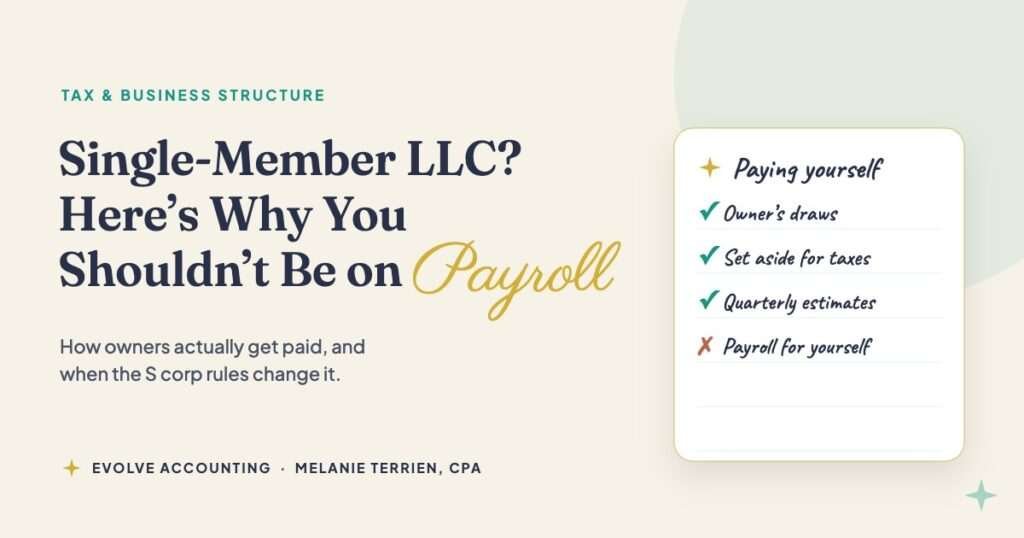
Here’s a situation I see all the time. Someone forms a single-member LLC, signs up for a payroll service, and starts paying themselves a regular paycheck with taxes withheld. It feels responsible and official, like what a “real” business owner should do.
It’s a completely understandable instinct. But in most cases, it’s not how a single-member LLC owner should be paid, and it can create a mess that takes real time to untangle.
Why you can’t be your own employee
By default, the IRS treats a single-member LLC as a disregarded entity. That means for income tax purposes, you and your business are the same taxpayer. Your business profit flows onto your personal tax return, usually on Schedule C.
Because of that, you can’t be an employee of your own single-member LLC. As the owner, you’re considered self-employed. Instead of payroll taxes, you pay self-employment tax (Social Security and Medicare) on your net earnings when you file your return.
So how do you pay yourself?
With an owner’s draw. You simply transfer money from your business account to your personal account. In your books, that transfer is recorded as a draw from your equity. It’s not an expense.
Two things surprise people here:
- Draws aren’t tax-deductible. They don’t reduce your business profit.
- You’re taxed on your profit, not on what you take out. Whether you draw every dollar or leave it all in the business, the tax is based on what the business earned.
What goes wrong when you run yourself through payroll
When a single-member LLC owner puts themselves on payroll, a few problems tend to follow:
- Your books show “wages” as an expense, which understates your real profit
- Payroll tax filings and W-2s get issued that don’t match how the IRS sees you
- You may pay payroll service fees and state payroll taxes you didn’t need to
- Fixing it usually means correcting payroll filings and reclassifying those wages as draws
None of this is the end of the world, and it’s fixable. But it’s much easier to set things up right from the start.
The big exception: the S corporation election
Everything changes if your LLC has elected to be taxed as an S corporation (by filing Form 2553 with the IRS). In that case, you are an employee of your business, and you’re required to pay yourself a reasonable salary through payroll, with any remaining profit taken as distributions.
Other situations work differently too. An LLC taxed as a C corporation can put owners on payroll, and a multi-member LLC taxed as a partnership has its own rules for paying owners. And of course, if you have employees who aren’t owners, they belong on payroll.
If you’re not sure how your LLC is taxed, check your IRS paperwork or ask whoever set it up. It makes all the difference.
What to do instead
If you’re a single-member LLC taxed the default way, here’s a simple setup that works well:
- Pay yourself with regular draws on a set schedule, like twice a month. A consistent rhythm makes budgeting at home much easier.
- Set aside money for taxes from every payment you receive, in a separate savings account.
- Make quarterly estimated tax payments. Since nothing is withheld, estimates are how you avoid a big bill (and possible penalties) at tax time.
- Keep business and personal money separate, so your draws are easy to track.
Should you elect S corporation status?
Sometimes, yes. Once your profit reaches a certain level, an S corporation election can reduce your self-employment taxes. But it also adds cost and complexity: running payroll, filing a separate business tax return, and paying yourself a salary that holds up as reasonable. It’s a decision to make with real numbers in front of you, not because someone said it’s what successful businesses do.
If you’re wondering whether your setup is right, or you think you might already be on payroll when you shouldn’t be, book a free discovery call. I’ll look at how your business is set up and help you figure out what makes sense. No judgment, just clarity.
This post is general information, not tax advice for your specific situation. Every business is different, so talk with a CPA before making changes.