
This is part 3 of my Advisory Gap series, on how much to pay yourself. Start with part 1 or part 2 if you’re just joining.
“How much should I be paying myself?” is one of the best questions a business owner can ask. And for most people, the honest answer right now is: whatever’s left over.
That’s understandable. But “whatever’s left” isn’t a plan. It means you get paid last, your income at home swings from month to month, and you never really know what your business can support. Your pay deserves to be a decision, not an afterthought.
First, a quick note on how you get paid
How you pay yourself depends on how your business is set up. Single-member LLCs and sole proprietors usually take owner’s draws. S corporation owners pay themselves a reasonable salary through payroll, plus distributions. I covered the details in why single-member LLC owners shouldn’t be on payroll. This post is about the other question: how much. If you’re an S corp, the salary part has to be a reasonable salary you can back up. The worksheet below flags this for you.
A simple way to decide how much to pay yourself
You don’t need a complicated formula. Here’s the approach I walk my clients through:
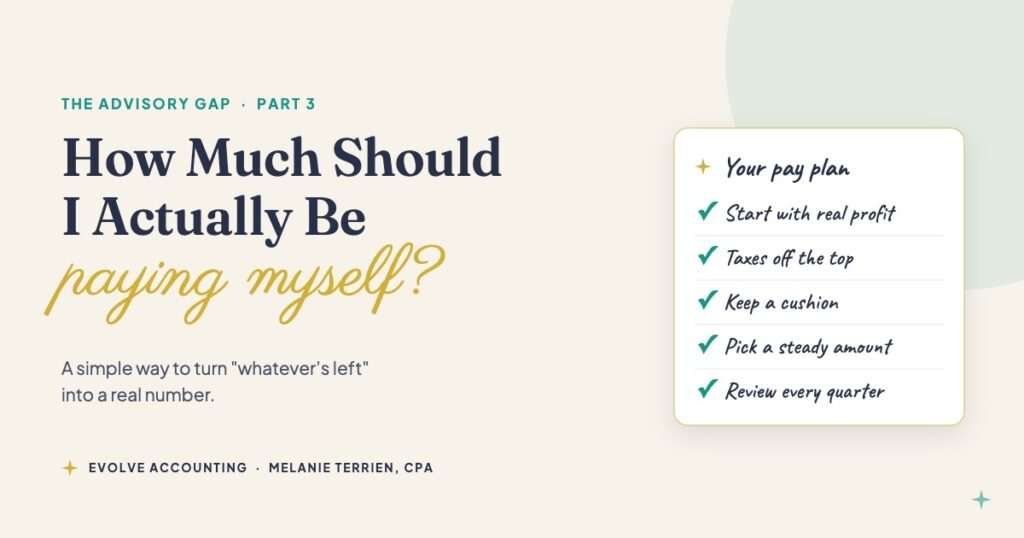
- Start with your actual profit. Look at your average monthly profit over the last six to twelve months. Use real, reconciled numbers, not a guess or your best month.
- Take taxes off the top. Your profit isn’t all yours to spend. Set aside a percentage for income and self-employment taxes before you decide what’s left for you.
- Leave something in the business. Build toward a cash cushion, ideally a few months of expenses, so a slow month or a late payment doesn’t become a crisis.
- Pick a steady amount. Whatever remains is the range you can safely pay yourself. Choose a fixed amount within it and pay it on a set schedule, like twice a month.
- Revisit it every quarter. As profit grows, give yourself a raise. If things slow down, adjust before it hurts.
Want to skip the math? My free Owner Pay Worksheet does it for you. Plug in your revenue and expenses and it shows a safe monthly amount after taxes and a cushion.
What if the number is too small?
Sometimes this exercise shows that the business can’t pay you what you need yet. That’s hard to see, but it’s much better to know. It usually points to one of a few things: prices that need to go up, costs that have crept up, or a business that needs more time to grow.
That’s not a failure. It’s information, and it’s exactly the kind of thing advisory is for.
Paying yourself is part of running the business
A business that can’t pay its owner isn’t finished yet. Treating your pay as a real line in your budget changes how you think about pricing, hiring, and growth. You stop asking “is there anything left?” and start asking “what does my business need to earn?”
Start with the free Owner Pay Worksheet to find your number, or if you want help, book a free discovery call. I’ll look at your numbers with you and help you set a pay plan that actually fits your business.
This post is general information, not tax advice for your specific situation. Every business is different, so talk with a CPA before making changes.